

ClabAir+ Physicochemical Laboratories: Enhanced Safety & Energy Efficiency
Diversified Air Distribution Control for Improved Safety
Targeted R&D and Testing Verification
Freshair’s R&D bases in Wuxi and Foshan are equipped with state-of-the-art spatio-temporal integration testing systems and full-condition airflow simulation laboratories. These facilities support in-depth research, including analysis on the dispersion of bioaerosols and chemical contaminants, as well as precise evaluation of how new aerodynamic products affect indoor airflow fields.
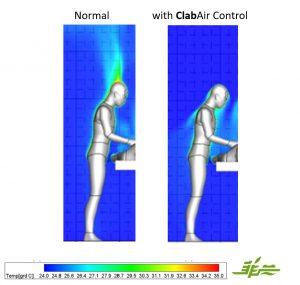
ClabAir Air Distribution Design Considering Human Thermal Plume
-Scientific Air Change Rate Regulation
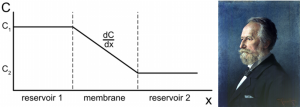
菲克第二定律
In accordance with Fick's Second Law
J=-D*dC/dX
Take the volatilization of chemical reagents in physicochemical laboratories as an example:
J:Volatilization rate of chemical reagents in test tubes or samples.
D:Diffusion coefficient. The value varies for different decorative materials due to differences in surface density and internal structure.
dC:Concentration difference of the reagent between the reagent surface and ambient air
dX:Thickness of the interface between the reagent and air.When ventilation volume increases, the value of dC rises. In accordance with Fick's Second Law, the volatilization rate of chemical reagents will accelerate accordingly. Therefore, once ventilation exceeds a certain threshold, the reagent concentration in the air can hardly be reduced further. Instead of relying merely on conventional displacement ventilation, Freshair adopts diversified air distribution control technologies to effectively cut down airborne reagent concentration in physicochemical laboratories and create a safer working environment.
Excerpts of Freshair Phys-Chem Lab Design Specifications
-Risk Control Inverted Triangle Model
For the control of hazardous factors in physicochemical laboratories, Freshair advocates applying the inverted triangle model for risk management and control, namely the Hierarchy of Controls Pyramid.

Risk Control Inverted Triangle Model
Process Layout
In light of the operational characteristics of physicochemical testing laboratories, a safe and comfortable working environment shall be established. Office areas shall be separated from experimental areas, forming non-controlled zones and controlled zones respectively.A physicochemical laboratory shall be equipped with offices, archives (report drafting room), sample receiving and storage rooms, large instrument rooms, small instrument rooms, balance rooms (glass volumetric apparatus calibration room), chemical experiment and sample pre-treatment rooms, drying rooms, washing rooms, ultrapure water preparation rooms, darkrooms and reagent storage rooms.Laboratory Wastewater Disposal and Treatment
The selection of drainage systems shall be determined based on the properties, flow rate and discharge pattern of wastewater, as well as on-site drainage conditions.Wastewater containing hazardous substances to be discharged externally must be separated from domestic sewage and other waste liquids. For relatively pure solvent waste liquids or valuable reagents, a cost-benefit analysis shall be conducted to assess the feasibility of recovery and reuse. All wastewater with toxic and harmful substances must undergo proper treatment and meet national discharge standards before being discharged into the urban sewer network. A water purification system is recommended for physicochemical laboratories. Large-scale food testing laboratories with high water consumption shall adopt a central water purification system.Laboratories for sample pre-treatment and chemical analysis involving strong acids and alkalis, as well as facilities with potential splashing or explosion risks, shall be equipped with emergency showers nearby.In washing rooms and other areas generating waste liquids, dedicated collection barrels shall be provided for classified collection, recovery and disposal. Ordinary laboratory wastewater may be directly sent to the wastewater treatment station. High-concentration acid and alkaline wastewater shall be neutralized prior to delivery to the treatment station. Wastewater containing radionuclides shall be classified into long-lived and short-lived categories according to their half-lives and treated separately. Large physicochemical laboratories are advised to build on-site supporting wastewater treatment stations.